Quadcopter Challenge: Inspiring STEM beyond the classroom
As the Quadcopter Challenge celebrates its 10th anniversary, three former students reflect on the lasting impact of participating in the inaugural 2015 final.
Raytheon’s Quadcopter Challenge is more than just a STEM competition – it can shape the careers of its alumni. Former students like Molly, who is a graduate trainee chartered accountant; Katy, a high school science teacher; and Filip, an analytical scientist, exemplify the lasting influence of the challenge beyond the classroom.
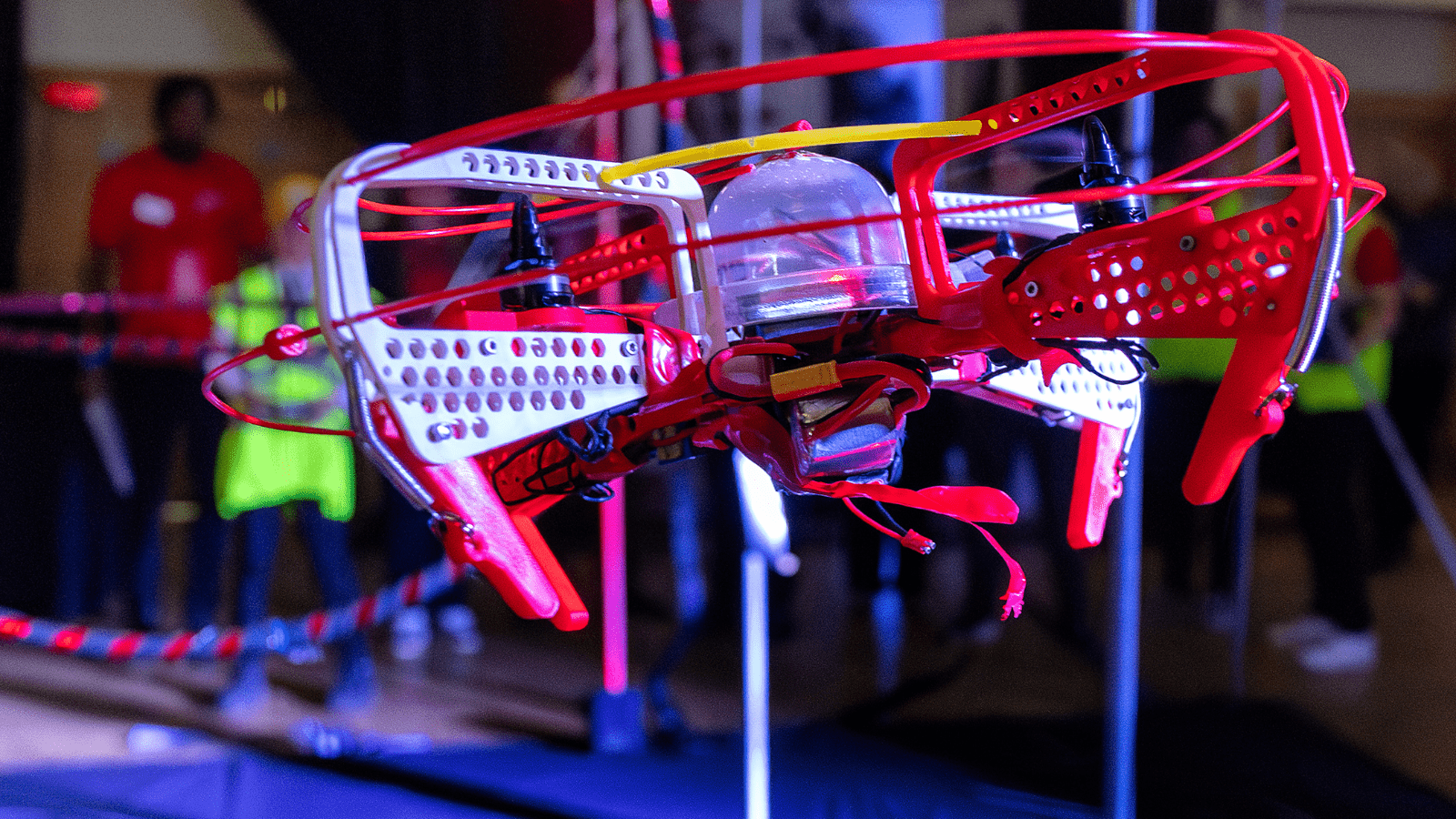
Representing a team from Harlow’s Stewards Academy, the trio won the 2015 competition to design, build, and fly a drone that offered an engineering solution to a real-world problem. While a shared interest in STEM motivated them to take part, it was the hands-on experience and mentoring that lay the foundation for their diverse professional paths.
“STEM has always been close to my heart, but the challenge allowed me to see the number of opportunities available within STEM fields that I would otherwise never have considered,” Molly said. “It inspired me to undertake a master’s in financial mathematics, eventually landing a position within a Big Four firm to pursue career in accountancy.”
Katy credits the guidance and mentoring support received during the challenge from Raytheon’s STEM Ambassadors as “solidifying” and “pivotal” to her development and outlook as a science educator.
“I really enjoyed taking part in the challenge as it allowed me to further explore my interest in engineering,” she said. “For instance, we got the opportunity to tour an airfield as well as see next-generation virtual reality technology being developed, which was incredible.”
As an analytical scientist, Filip solves complex problems by thinking outside the box.
“The challenge taught me to systematically test each variable when analysing technical materials,” he said. “This systematic thinking and troubleshooting ensures that the experiments I design are purposeful and effective, rather than relying on random trial and error to find solutions – a skill set akin to what we employed when designing, building, and flying our quadcopters.”
Interdisciplinary skills
Molly and Katy said they too have found the skills learned from the challenge to be highly relevant within their professions.
Molly highlights the problem-solving mindset developed during the competition, which she applies to her role working in financial audit.
“When we were flying the quadcopter around the course, quick-thinking and approaching challenges from different angles were crucial,” she said. “Working as I do in a fast-paced environment, where things are constantly changing, it’s imperative that any issues are resolved quickly and efficiently, and the ability to look at these from multiple angles helps greatly.”
The challenge also piqued Molly’s interest in engineering-style projects and gave her the impetus to try her hand at 3D printing, remote-controlled robots, and coding.
“I’m still deciding what I want to do as a career long-term,” Molly said. “However, accountancy opens many doors that will allow me to combine a financial role with these technical interests that I’ve developed from the challenge, especially with coding.”
The collaborative and creative, hands-on learning seen in the challenge has influenced Katy’s teaching style. She prioritises student engagement and incorporates fun, interactive methods into her plans.
“The fun lessons are often the ones that stick with students more,” Katy said. “What that looks like varies. If I’m teaching about cells and organelles, I play an organelle song to the class. I have another song about the electromagnetic spectrum and the noble gases. Other times, we play revision bingo, solving questions to complete bingo cards. I’ve also created an escape room, where students test their understanding of chemistry to escape, and a biology murder mystery, where each correct answer provides another clue.”
Reflecting on the challenge
The trio agrees that the problem-solving skills, resilience, and teamwork required for Raytheon’s Quadcopter Challenge set a precedent for their professional lives. Victory was simply the icing on the cake.“Competitions like this are a valuable way for students to gain awareness of industries around them and the type of work involved,” Filip said. “The experience of persevering in the face of difficulty is a universal skill to learn. Building a functional quadcopter involves trial and error. Learning to fly it requires dedication, and seeing the fruits of your labour justifies the effort spent.”
Molly encourages students to get involved, adding that “without experiences like the quadcopter challenge, students may not learn about all the different pursuits available within STEM.”
Katy wants students at her school to experience the opportunities she had. Last year, she set up a club to encourage and support students from Year 7 all the way up to sixth form in entering a stream of national STEM competitions.
“I also run the Key Stage 3 science club, where students rotate through biology, chemistry, and physics experiments,” she said.
In fact, next year, her challenge journey may come full circle.
“I’m looking into running the quadcopter challenge at my school when the competition opens up again,” Katy said.